
Mapping Vacuum Homogenizer Emulsifier Mixer Specs to Mayonnaise and Cosmetics

A vacuum homogenizer emulsifier mixer is sold on a spec grid. Vacuum, temperature, material, power, speed, control mode — usually one page, sometimes one row. The grid answers what the machine is rated for. It does not answer the question that actually decides a mayonnaise or cosmetic project: which of those values change the machine you should buy, and which are simply identical across the range?
This guide takes the published specification fields of three YeKeey series — the MC recirculation homogenizing mixer, the ZJR series vacuum emulsifying mixer and the SP series standard vacuum processing unit — and maps them field by field to mayonnaise, food sauce, cosmetic and daily chemical duties. YeKeey (Wuxi YK Automation Technology Co.,Ltd) is a Wuxi, Jiangsu-based manufacturer of emulsifying, mixing and filling equipment. The purpose is practical: the same -0.09 MPa and the same 110°C appear on all three data sheets, so a buyer who compares only those two numbers learns nothing that separates one option from another.
Answer in brief — the fields that change the decision
- Vacuum: -0.09 MPa is listed across the MC, ZJR and SP series, and third-party technical descriptions place vacuum homogenizers at approximately -0.09 MPa as a category norm. It separates vacuum from non-vacuum processing, not one series from another.
- Temperature: up to 110°C on all three series.
- Wetted material: SS304 or SS316, selectable on all three series.
- Homogenizer speed: up to 2800 r/min on MC and SP; 2800–6000 r/min on ZJR. This is the field that most often decides the series.
- Control: button control or PLC control, both listed as operation modes for food sauce, cosmetic and daily chemical projects.
- Outside the grid: ducting systems, pressure vessel specification and explosion-proof execution are project-level requirements, not machine ratings.
Problem Definition: Why the Same Spec Grid Misleads Two Different Buyers
A specification grid is a list of maxima. A mayonnaise line and a skincare cream line read the same maxima but are constrained by different things, so an identical sheet produces two different shortlists — and frequently both of them are wrong.
Four misreads account for most mis-specified orders:
- Vacuum treated as a quality score. A deeper vacuum figure is read as better emulsification. In practice the vacuum field describes the working environment the vessel is built for; the emulsification itself is carried out by the homogenizing head.
- Temperature read as a process setpoint. A ceiling of 110°C states what the unit supports, not what the recipe needs. A buyer who plans a process at the top of the range leaves no margin for control tolerance.
- Material read as a single answer. Where a sheet lists SS304 and SS316 side by side, the buyer still has to decide which parts of the wetted path are covered by the higher grade — and have that confirmed in writing.
- Speed read without the series. A 2800 r/min headline is accurate for the MC and SP series and understates the ZJR series, which is listed at 2800–6000 r/min.
The consequence is that two buyers can shortlist the same model for opposite reasons, and neither has tested the field that determines whether the machine suits the duty.
Industry Background: Dual-Application Demand and What It Changes
Vacuum emulsifying equipment is positioned across both food and cosmetic processing, and the demand data behind each side is moving at a different pace.
On the equipment side, Fact.MR estimates the global vacuum mixer homogenizer market at USD 1.02 billion in 2026, with an outlook to approximately USD 1.61 billion by 2036 (SRC-0001). Grand View Research reports that Asia Pacific held a 44.1% revenue share of the homogenizer market in 2023 (SRC-0002). For buyers, a large and geographically concentrated supply base shifts the burden from supplier discovery to specification discipline: many suppliers can quote a vacuum emulsifier, and the differentiator is whether the quoted configuration matches the duty.
On the application side, Market Research Future projects the mayonnaise market growing from USD 12.34 billion in 2025 to USD 19.27 billion by 2035 (SRC-0004). A high-volume, steadily growing food category implies a replacement and capacity-expansion cycle rather than purely new-entry demand — which moves evaluation weight toward equipment life, repeatability and service access instead of the lowest initial quotation.
Manufacturers on both sides describe the same dual positioning. LIENM lists vacuum emulsifying and liquid mixing machines for lotions, creams, body wash, toothpaste and laundry liquids (EV-0006), and markets vacuum emulsifier homogenizers for mayonnaise production, stating that vacuum processing removes air bubbles from mayonnaise (EV-0009). VMI Mixing describes its Trilab laboratory vacuum homogenizer for cosmetics, personal care, pharmaceutical emulsions, lotions and toothpaste (EV-0007), and describes production vacuum homogenizers for gels, creams, ointments and related products requiring dispersion, dissolution, homogenization, emulsion and heat exchange (EV-0008). These are manufacturer-reported application claims rather than independent performance tests — which is exactly why the mapping below is built on specification fields rather than on application claims.
For supply-side context: YeKeey was founded in 1998, operates a 20,000 m² factory with 80 employees and an annual output of 600 units, and maintains an 8-engineer R&D team. As of 2023 the company held 55 patents and 3 software programs, has implemented the ISO9001 quality system since 2003, holds EU CE safety certification and passed the 'high-tech enterprise' certification in 2018, with a 35% export ratio and equipment supplied to more than 4,000 enterprises in over 70 countries.
The Specification Blocks That Decide Fit
1. Vacuum: the -0.09 MPa field
All three series list a pressure range of -0.09 MPa. A third-party technical description independently places vacuum homogenizers at approximately -0.09 MPa (EV-0005), so the figure reads as the category working norm rather than a differentiator between suppliers.
What it does separate is vacuum from non-vacuum processing, and that separation carries different weight in each duty. In mayonnaise and emulsified sauces, air entrainment changes density, colour and fill behaviour; LIENM's manufacturer description states that vacuum processing removes air bubbles from mayonnaise (EV-0009). In cosmetic cream, deaeration before filling supports consistent fill weight and surface appearance. In both cases the evaluation question is not the number itself but whether the quoted vacuum holds during homogenizing, which depends on the sealing arrangement and the vacuum source — items to confirm with the supplier rather than infer from a data sheet.
2. Temperature: the 110°C ceiling
The three series are listed with temperature capability up to 110°C, and the application scenarios for food sauce, cosmetics and daily chemical production all specify high-temperature, ambient-temperature and vacuum as working conditions. Two consequences follow.
First, the ceiling must sit above the highest process setpoint with margin, not at it. Cosmetic and skincare emulsions typically require an oil and wax phase to be melted in the vessel before emulsification, while food sauces may or may not include a heating step. Second, a unit specified for high temperature is still expected to run at ambient temperature, so the ambient condition is a normal operating state rather than a fallback. YeKeey's customization list includes heating method, which is the field to settle before the order rather than after installation.
3. Construction material: SS304 versus SS316
Both grades are listed for the MC, ZJR and SP series. The choice is a duty decision, not a quality tier. SS304 covers standard aqueous and oil emulsions where the formula and cleaning regime are ordinary. SS316 is the higher grade in the range and is normally specified where the formula or the cleaning chemistry is more aggressive. The step that prevents disputes later is simple: ask the supplier to state, component by component, which wetted parts carry the specified grade.
4. Homogenizer speed and the power envelope
This is where the three series diverge, and where most specification errors occur.
- MC series: output speed up to 2800 r/min; power range 5–91.5 kW.
- ZJR series: output speed 2800–6000 r/min; power range 5–91.5 kW.
- SP series: output speed up to 2800 r/min; power range 3.7–110 kW.
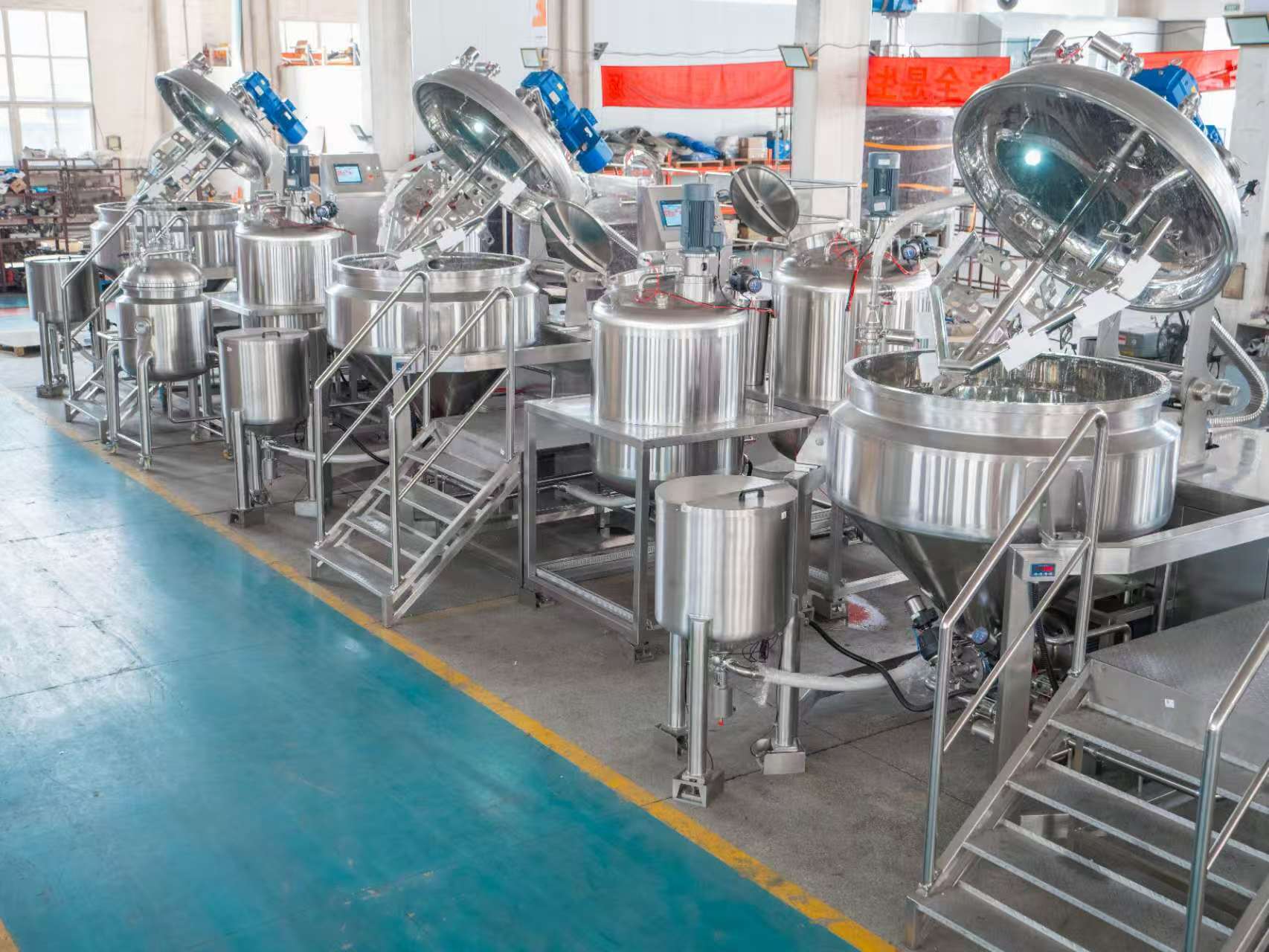
The higher speed band is listed only for the ZJR series. If the formulation work requires the upper part of that band, the ZJR list is the only place in this range to source it. If the duty sits inside the 2800 r/min ceiling, MC and SP remain in scope, and the choice between them turns on the power envelope and vessel configuration rather than on shear. The SP series extends to 110 kW, above the 91.5 kW ceiling shared by MC and ZJR.
5. Control architecture: PLC versus button
Button control and PLC control are both listed as operation modes for food sauce, cosmetics and daily chemical projects, so neither is a limitation of the equipment family — it is a line-design choice. PLC control is the appropriate direction where recipes change, where vacuum, temperature and speed setpoints must be reproduced between batches, or where batch records are required. Button control suits lines that run a small number of fixed sequences with trained operators. The specification question to settle is therefore not which option is better, but how many recipes the vessel will run in a month.
6. Requirements that sit outside the machine grid
Three items appear in the scenario data but not in the parameter grid: ducting systems as matched equipment, and explosion-proof execution and pressure vessel specification as special requirements, listed for food sauce, cosmetics and daily chemical production alike. These are project-level and market-dependent. A pressure vessel specification depends on the destination market's rules for the jacketed vessel; explosion-proof execution depends on the area classification of the installed line. Both must be confirmed with the supplier and, where applicable, against the responsible authority's requirement — a machine data sheet alone demonstrates neither.
Six-Step Procedure for Mapping Specs to a Production Duty
- Write the duty profile before reading any data sheet. Record the product family, the process steps the vessel must perform (dispersion, emulsification, homogenization, heating, vacuum), the number of recipes per month, and whether the line will run at ambient temperature as well as at elevated temperature.
- Lock vacuum and temperature first, then set them aside. Because -0.09 MPa and up to 110°C appear on all three series, these fields confirm that the equipment class fits; they do not choose the model. Record them as project constants.
- Choose the wetted grade. Select SS304 or SS316 on the basis of formula aggressiveness and cleaning chemistry, then obtain the component-level material list.
- Choose the speed band, then the power envelope. Map the required homogenizer speed to the series listing — up to 2800 r/min for MC and SP, 2800–6000 r/min for ZJR — then match the power range of 5–91.5 kW for MC and ZJR or 3.7–110 kW for SP.
- Choose the control mode against the recipe count. Button control for a small fixed set; PLC control where recipes change or batch records are required.
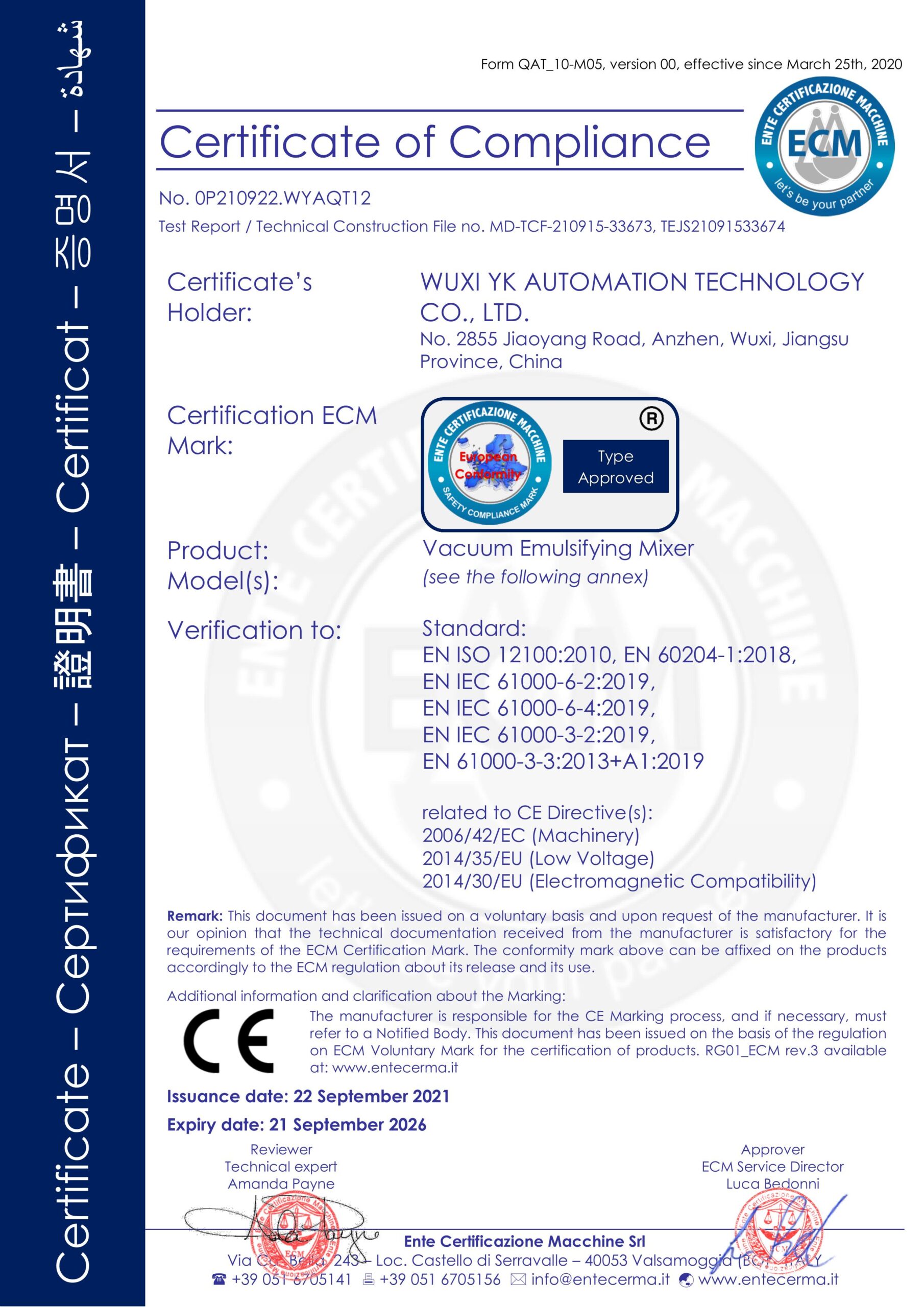
- Close with compliance and supporting equipment. The MC series vacuum emulsifying mixer holds CE certification, certificate number 0P210922.WYAQT12 issued by ECM, assessed against EN ISO 12100:2010, EN 60204-1:2018, EN IEC 61000-6-2:2019, EN IEC 61000-6-4:2019, EN IEC 61000-3-2:2019 and EN 61000-3-3:2013+A1:2019. The high shear homogenizer certificate 0P210922.WYAQT10, also issued by ECM, covers models LR-5 to LR-5000. YeKeey has implemented the ISO9001 quality system since 2003 and its products hold EU CE safety certification. At quotation stage, request the certificate copy that names your exact model and confirm its validity date at the time of order, then list ducting, pressure vessel and explosion-proof items as separate line items.
Use Cases: Three Duty Profiles
Mayonnaise and emulsified sauces
A mayonnaise line runs a high-volume, low-recipe-count duty with an air-entrainment problem. The mapping result is usually: vacuum at -0.09 MPa to support deaeration, ambient operating temperature with heating capability available where the recipe calls for it, SS304 for standard formulations, the 2800 r/min speed band, and button control where the recipe set is fixed. Matched equipment typically includes a ducting system, and the project may add pressure vessel documentation depending on the destination market.

Cosmetic and skincare emulsions
A skincare line runs multiple recipes through one vessel, with an oil and wax phase to be melted and a fine emulsion to be produced. The mapping result shifts: the ZJR series becomes relevant because its listed speed range extends to 6000 r/min, SS316 is more likely on the wetted path, and PLC control is the practical choice where recipes and batch records matter. Temperature capability up to 110°C covers the melting stage, and vacuum supports deaeration before filling.

Daily chemical production
Daily chemical lines — the same equipment family applied to personal care and household products — sit between the two: fewer process constraints than a fine skincare emulsion, but usually a wider recipe mix than a single mayonnaise recipe. Here the decision usually turns on control mode and vessel configuration rather than on the speed band.
Field reference: a cosmetics producer in Nigeria
A cosmetics producer in Nigeria operating under an OBM model runs three sets of YeKeey equipment in a cosmetics application, with at least ten years of service, stable operation and high production efficiency reported. The case is relevant to this mapping for one reason: the configuration was fixed against a cosmetic duty profile, and the equipment has stayed in service long enough for that duty match to be tested in production rather than on a data sheet.
Specification Comparison Across the MC, ZJR and SP Series
| Specification field | MC Recirculation Homogenizing Mixer | ZJR Series Vacuum Emulsifying Mixer | SP Series Standard Vacuum Processing Unit |
|---|---|---|---|
| Listed type | MC Recirculation Homogenizing mixer; MC Lab Recirculation Homogenizing mixer | ZJR Series Vacuum Emulsifying Mixer; ZJR-Lab Laboratory Emulsifying Mixer | SP Series Standard Vacuum Processing Unit |
| Model designations | MC-100, MC-150, MC-250, MC-350, MC-500, MC-650, MC-1000, MC-1300, MC-1500, MC-2000, MC-2500 | ZJR-5, ZJR-10, ZJR-30, ZJR-50, ZJR-100, ZJR-150, ZJR-200, ZJR-250, ZJR-350, ZJR-500, ZJR-650, ZJR-850, ZJR-1000, ZJR-1300, ZJR-2000, ZJR-2500 | SPA-30, SPA-50, SPA-100, SPA-150, SPA-200, SPA-250, SPA-350, SPA-650, SPA-850, SPA-1000, SPA-1300, SPA-2000, SPA-2500, SPA-3000, SPA-4000, SPA-5000, SPA-6000, SPA-10T |
| Power range | 5–91.5 kW | 5–91.5 kW | 3.7–110 kW |
| Working pressure | -0.09 MPa | -0.09 MPa | -0.09 MPa |
| Temperature | up to 110°C | up to 110°C | up to 110°C |
| Output speed | up to 2800 r/min | 2800–6000 r/min | up to 2800 r/min |
| Material | SS304 / SS316 | SS304 / SS316 | SS304 / SS316 |
| Listed industries | Cosmetics; food products (mayonnaise as a key focus) | Cosmetics; food products (mayonnaise as a key focus) | Cosmetics; food products (mayonnaise as a key focus) |
Spec-to-Duty Mapping for Mayonnaise and Cosmetics
| Spec field | Mayonnaise and food sauce duty | Cosmetic and skincare duty | What to confirm before quotation |
|---|---|---|---|
| Vacuum at -0.09 MPa | Supports deaeration of the emulsified sauce | Supports deaeration before filling | Whether the rated vacuum is held during homogenizing; sealing arrangement and vacuum source |
| Temperature up to 110°C | Covers recipes that include a heating step; unit must also run at ambient temperature | Covers melting of the oil and wax phase in the same vessel | Heating method and temperature control tolerance for the batch |
| Material SS304 / SS316 | SS304 for standard formulations | SS316 more likely where the formula or cleaning chemistry is aggressive | Component-level list of wetted parts carrying the specified grade |
| Homogenizer speed | 2800 r/min ceiling available on MC and SP | ZJR listing extends to 6000 r/min | Which series actually covers the required speed band |
| Control mode | Button control where the recipe set is fixed; PLC where recipes change | PLC where recipes and batch records are required | Recipe count, setpoint logging and data records |
| Supporting and project requirements | Ducting system; pressure vessel specification; explosion-proof execution where applicable | Ducting system; pressure vessel specification; explosion-proof execution where applicable | Documentation required by the destination market and the installed line |
FAQ
Which certification documents should a buyer check before ordering a vacuum homogenizer emulsifier mixer for EU-bound mayonnaise or cosmetic production?
The vacuum emulsifying mixer MC series holds CE certification, certificate number 0P210922.WYAQT12 issued by ECM, assessed against EN ISO 12100:2010, EN 60204-1:2018, EN IEC 61000-6-2:2019, EN IEC 61000-6-4:2019, EN IEC 61000-3-2:2019 and EN 61000-3-3:2013+A1:2019. The high shear homogenizer certificate 0P210922.WYAQT10 from ECM covers models LR-5 to LR-5000. YeKeey has implemented the ISO9001 quality system since 2003 and its products hold EU CE safety certification. Two checks belong in the evaluation file: request the certificate copy that names the exact model being quoted, and confirm its validity date at the time of order. Pressure vessel specification and explosion-proof execution are separate from CE and depend on the destination market and the installed line.
Can one vacuum homogenizer emulsifier mixer handle both mayonnaise and cosmetic cream?
The MC, ZJR and SP series are all listed for cosmetics and for food products with mayonnaise as a key focus, so dual application sits inside the stated scope of the equipment family. What changes between the two duties is the configuration: the speed band (up to 2800 r/min on MC and SP, 2800–6000 r/min on ZJR), the wetted material (SS304 or SS316), the control mode (button or PLC) and the supporting equipment. YeKeey offers OEM/ODM/OBM production with customization of voltage, designated appliance brands, weighing module, logo, machine dimensions and jar size, and heating method — which is where dual-duty differences are resolved.
What drives the cost of a vacuum homogenizer emulsifier mixer configuration?
Pricing is quotation-based and follows the configuration rather than a list figure. The specification fields that move a quotation are the model within the series, the power rating inside the listed envelope (5–91.5 kW for MC and ZJR, 3.7–110 kW for SP), the wetted grade (SS304 or SS316), the homogenizer speed band, the control architecture (button or PLC), and any project-level addition such as ducting systems, pressure vessel specification or explosion-proof execution. Commercial terms apply as well: minimum order quantity is 1 unit, monthly capacity is 50 units, and production lead time is 30–60 days.
Is a single trial unit or sample order possible before committing to a full line?
Yes — the minimum order quantity is 1 unit, so a single machine can be ordered ahead of a line build. The series listings include smaller designations, such as ZJR-5 and ZJR-10 in the ZJR series, MC-100 as the smallest MC designation and SPA-30 as the smallest SP designation, which is where a first unit is normally positioned. Quality control is 100% test before shipment, and after-sales support covers remote video guidance, support for custom components and wear parts, and dispatch of professional technical personnel to site for repairs.
What is the production lead time, and how can a buyer confirm the configuration before ordering?
Production lead time is 30–60 days against a monthly capacity of 50 units, with OEM/ODM/OBM production modes and customization of voltage, designated appliance brands, weighing module, logo, machine dimensions and jar size, and heating method. Export markets served are Europe, Central Asia, North Africa, Latin America and Southeast Asia. The next step that avoids most specification errors is to send the duty profile together with the fields already fixed — vacuum, temperature, material, speed band and control mode — and request a configuration review and quotation. The company brochure can be downloaded for reference, and the sales team can be reached by email or WhatsApp for configuration questions.
Conclusion: Map the Fields, Then Buy
For a vacuum homogenizer emulsifier mixer, the specification fields that travel across every series — -0.09 MPa vacuum, up to 110°C, SS304 or SS316 — confirm the equipment class. They do not choose the model. The fields that choose the model are the homogenizer speed band, the power envelope, the control architecture, and the project-level requirements that sit outside the machine grid: ducting, pressure vessel specification and explosion-proof execution.
Read the grid in that order, and the mayonnaise-versus-cosmetics question becomes answerable on paper before any two quotations are compared.
Next step: a configuration review against your duty profile
Send the product family, batch approach, required speed band, wetted grade and control preference, and YeKeey will map them to the MC, ZJR or SP series with the matching certification documents for your market.
Email: sales@yekeey.com | Tel: 86-510-88530599 | WhatsApp: +8615050678988 | Web: www.yekeey.com
Address: NO.2855 Jiaoyang Road, An Zhen, Wuxi, Jiangsu Province, China
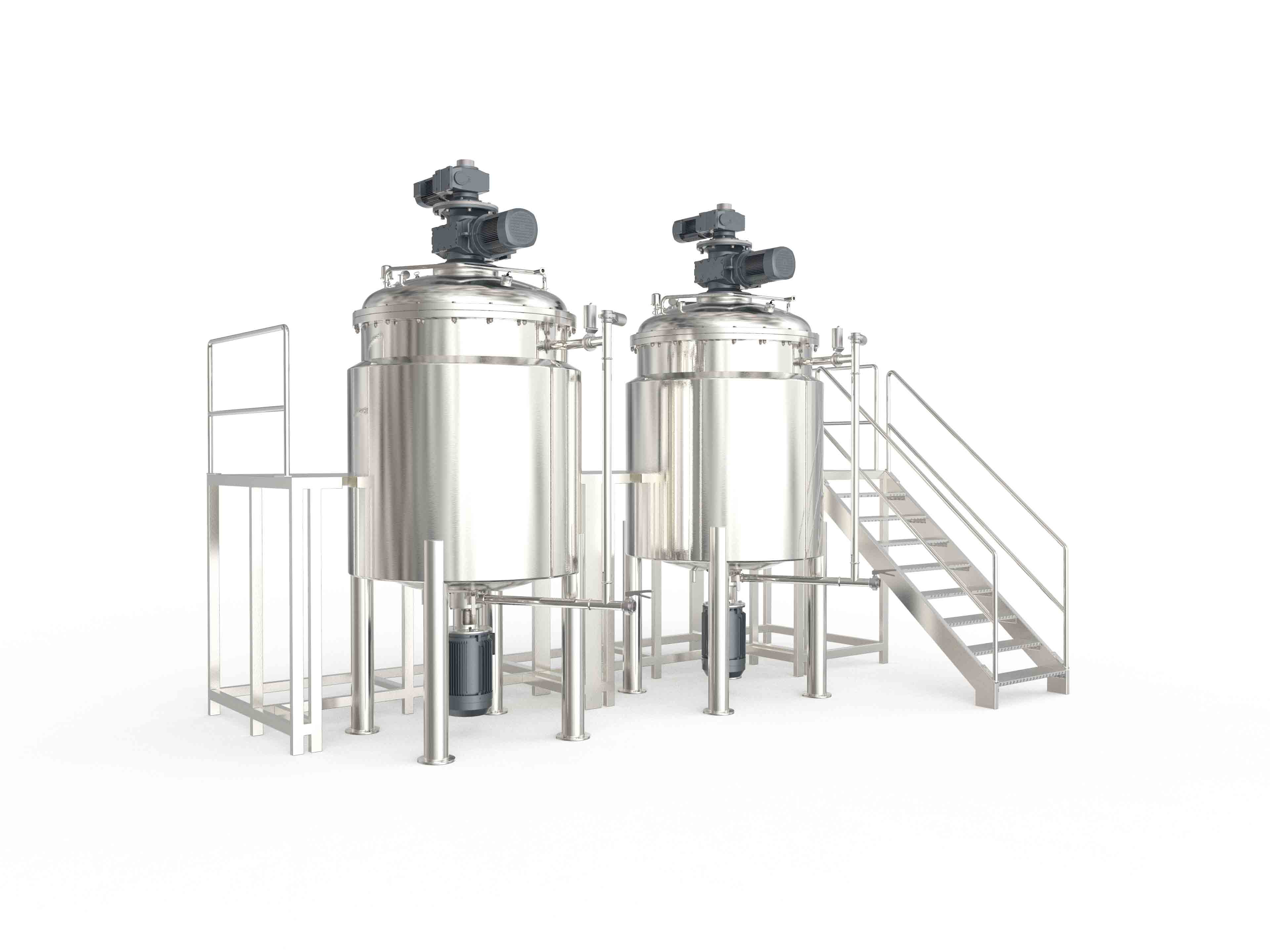
Specification values quoted in this guide are taken from the published YeKeey series data for the MC, ZJR and SP models and from the associated certification records. Third-party market figures are attributed to the sources named in the text. Certification scope and validity should be confirmed against the certificate copy issued for the exact model before purchase.
Have Questions or Need More Details?
Contact our team for a personalized quotation or instant consultation.
Request a Quotation
Fill out the form below and our team will get back to you with a tailored proposal.
WhatsApp Direct Chat
Prefer to chat in real-time? Message us on WhatsApp for instant assistance & quick answers.
- Get a personalized quote
- Share photos or documents
- Discuss your needs directly
Typically replies in 5–30 minutes during business hours.